
Who we are.
Co-founder | Consultant
Tharunkumar A.R

Hi! I’m Tharun, an incoming freshman at Stanford pursuing Mechanical Engineering + Computer Science. In high school, I was the Project Manager and Hardware Lead for FTC Robotics Team 4545 Ouroboros and the Director of Operations at FolioLearning. Beyond robotics, I’m a passionate photographer, mridangist & cinephile. I figured the best way to introduce myself to you would be the same way I introduced myself to my roommate at Stanford. Here goes:
My response to the Stanford Roommate Question.
Hey!
I’m Tharunkumar Ananthakumaran Rajeswari–you can call me Tharun (Thuh-roon). Don’t worry too much about pronunciation–I’ve even responded to ‘Takoo-Takoo.’
How are you today? If you’re nervous about leaving home–I feel you. This is now my thirteenth educational institution, and this dorm is about to be the twelfth place I’d call ‘home.’ But if my moves have taught me anything, it’s this: find your people, and you’ll find your place.
To me, finding good ice cream is just as important. I’m a die-hard ice cream junkie, and I consume it in pints. However, I do have a rather quirky rule–I can’t eat ice cream more than once a week. As a result of a ritualistic promise made to the Ganges River at Varanasi, India, I vowed to sacrifice something I love. I love ice cream. So, I sacrifice it Sundays-Fridays.
The one thing I love more than ice cream? Movies. I’ve become fluent in four languages throughout my moves, meaning I have four cultures worth of rom-coms to happy-cry to. Hit me up if you’re willing to be my cinema buddy.(:pleading_face_emoji:)
One last thing. If you find me at Terman Fountain, gazing blankly into the distance–fret not. I am still alive. It’s just that I spend ten minutes a day doing nothing. Just like how the value of water is rooted in thirst, I believe that the beauty of an eventful day is derived from moments of doing nothing.
I can’t wait to meet you!
One of your people,
Tharun
Co-founder | Consultant
Nipun Nagendra
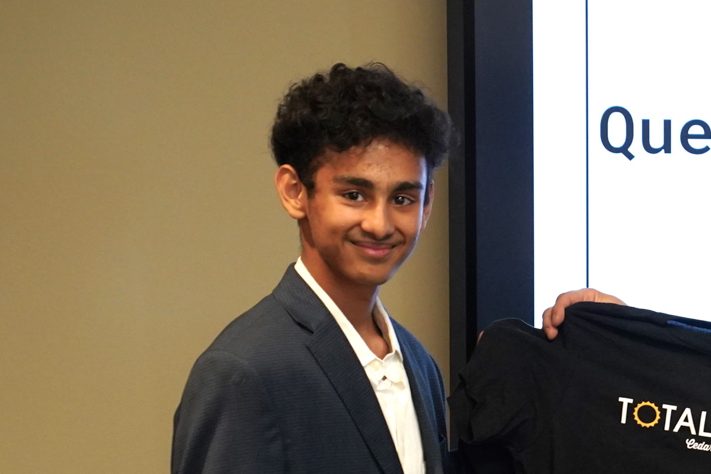
Hey, I’m Nipun — a rising freshman at Cornell University, where I’ll be studying Astrophysics and Statistical Science. I love research and have spent the past few years writing/publishing three papers on galaxy clusters and cosmology. I’m also passionate about community service, especially through my advocacy with the Dark Sky movement to reduce light pollution. Outside the lab and classroom, I’m an avid astrophotographer, filmmaker, and public speaker, and I enjoy exploring big questions through Metaphysics.
The essay that got me into Cornell
Every so often, a discovery comes along that changes everything, from the spinning jenny, to Newton’s Law of Gravity, to CRISPR technology. The next big thing just might come from studying the Cosmic Microwave Background (CMB) – aka “the aftermath of the Big Bang”, which has the potential to revolutionize our understanding of the origin of the universe, and transform modern physics as we know it.
For as long as I can remember, I’ve been fascinated by the universe. It began with a hobby in astrophotography, capturing startling full-color images of the four Galilean moons of Jupiter, the Great Orion Nebula, and the elusive Green Comet (last seen during the Ice Age). It morphed into the thrill of scholastic competition, where I qualified for nationals in the US Astronomy and Astrophysics Olympiad (USAAAO). And it expanded into books, where I devoured anything I could get my hands on, including Dale Ostlie’s seminal “Introduction to Modern Astrophysics,” which compelled me to combine spherical trigonometry with data science to plot my very own 3D map of more than 10,000 stars.
Hungry for more challenges, I turned to research universities. I was accepted to UT Austin’s High School Research Academy (HSRA), where I studied computational astrophysics and spent five weeks in a small team environment learning how to use SQL and machine learning to analyze scientific databases. In addition to making great friends and learning from leading professors, I was able to publish two research papers under world-renowned astrophysics/CS Professor [REDACTED]: one that proved Carpenter/de Vaucouleurs’ 20th century theory of density-size restriction using machine learning on big data sets (JEI), and the other that compiled almost 100 years of literature on their density research to assess the impact on other cosmological models (JSR). I was also accepted to a month-long summer program at Columbia called “Astronomy and Astrophysics” (taught by [REDACTED]) which focused on the mathematical end of astrophysics; my daily problem sets inspired me to write a research paper for my IB Math class where I solved for dark matter using calculus.
But the most exhilarating chapter in this journey began this year when I connected with Texas A&M Professor Kevin Huffenberger, a prominent astrophysicist who’s on the Executive Team of CMB-S4, the global network of scientists and educators studying the Cosmic Microwave Background. After a series of back-and-forth emails and interviews, he graciously invited me to join his cutting-edge research on galactic clusters identified by the CMB, which I am working on now.
Cornell represents the next logical step in my development, and I plan to major in Astronomy with an Astrophysics Concentration. Cornell is the only university in the country with four professors who each specialize in a different critical aspect of the CMB-S4 project. There’s Professors Battaglia and Bean, who work on different theoretical components; Professor Crites, who specializes in instrumentation; and Professor Niemack, who’s focused on data analysis. This comprehensive, cross-disciplinary collaboration is at the heart of a Cornell education, and will provide me with the breadth and depth of opportunities to study courses ranging from “Galaxies Across Cosmic Time” to “Multiwavelength Astronomical Techniques.”
Beyond the classroom, I’m excited to join the CCAT-prime project team (a Cornell-led international consortium behind a revolutionary telescope), and I was lucky enough to get a personalized tour of the lab this summer from Professor Crites. I hope to become a regular participant at seminars and guest lectures sponsored by the Center for Astrophysics and Planetary Science, to both learn from, and contribute to, discussions on the latest research in the field. Naturally I plan to join Cornell’s Astronomy Club to meet with students from all over the world who share a common passion for our place among the stars.
To me, Cornell represents the perfect “home planet,” that rare snow-covered goldilocks zone where interdisciplinary approaches flourish, collaboration thrives, theories evolve, friendships grow, and where the next big breakthrough could be just beyond the Slope.
